
Do you ever look in the mirror and sigh at the sight of new dark spots or a general dullness to your skin? Have you tried countless brightening products with disappointing results? What if the secret to a luminous, even-toned complexion wasn’t in a high-tech lab, but hidden within a centuries-old Japanese tradition?
For generations, it has been observed that the hands of sake brewers (tōji) in Japan remain inexplicably smooth, clear, and youthful, despite their age and demanding physical labor. This curious phenomenon led scientists to a remarkable discovery: a natural compound produced during the rice fermentation process. This article will unveil the science behind that secret—Kojic Acid—and explain how this gift from a humble fungus can help you achieve the bright, flawless skin you’ve been dreaming of.
What Are Koji and Kojic Acid?
Koji is, to put it simply, steamed rice that has been inoculated with a special fermentation culture, Aspergillus oryzae. This mold is the cornerstone of many essential Japanese food products, including soy sauce, miso, and of course, sake. As A. oryzae breaks down the starches in the rice, it produces a variety of enzymes and metabolites, one of which is the powerful skin-lightening agent, Kojic Acid [1].
First isolated in 1907, Kojic Acid has moved from the sake brewery to the forefront of the global skincare industry. Why the sudden fame? Because scientists have confirmed what the tōji have known for centuries: Kojic Acid is remarkably effective at addressing issues of hyperpigmentation. It offers a naturally derived alternative to other harsh brightening agents, backed by over a century of observation and modern scientific validation.
The 3 Scientific Reasons Kojic Acid Works Wonders on Skin
Kojic Acid isn’t just a folk remedy; its effectiveness is rooted in well-understood biological mechanisms. As a microbiologist, I find its multi-faceted approach to skin health truly fascinating. Here’s how it works, explained simply.
1. It Shuts Down the
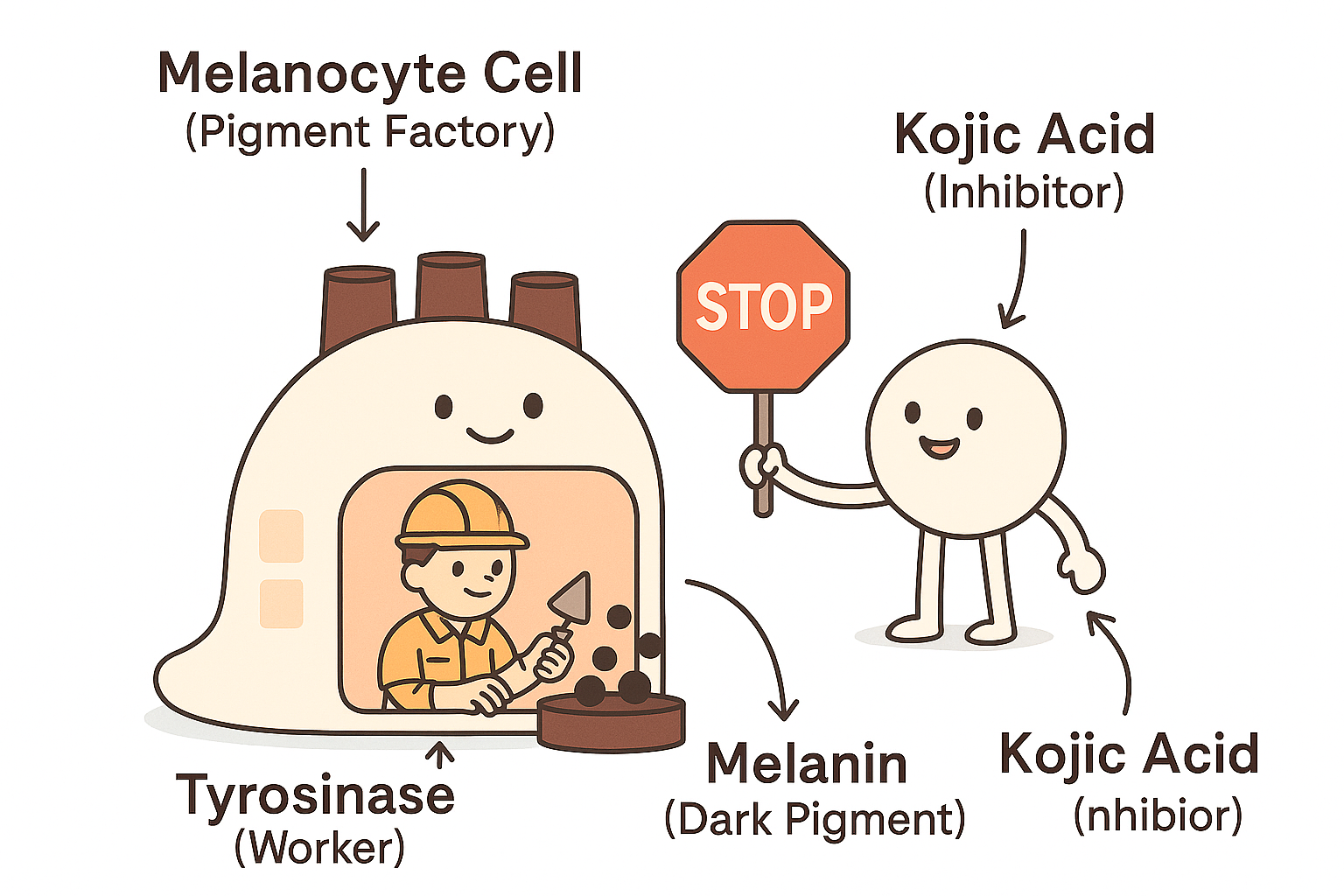
Your skin color and dark spots are determined by a pigment called melanin. Melanin is produced in specialized cells by an enzyme named tyrosinase. Think of tyrosinase as the key worker in your skin’s pigment factory. More active workers mean more melanin production, leading to darker spots and an uneven skin tone.
Kojic Acid’s primary and most famous function is its ability to inhibit tyrosinase. It does this by binding to the copper ion at the enzyme’s active site, effectively preventing it from working [2]. By telling this key worker to take a break, Kojic Acid slows down the production of melanin. This scientifically-proven mechanism, detailed in numerous studies including the highly-cited paper “Kojic acid, a cosmetic skin whitening agent, is a slow-binding inhibitor of catecholase activity of tyrosinase,” is the main reason it is so effective at fading dark spots, sun damage, and post-acne marks [3].
2. It Acts as a Powerful Antioxidant
Every day, your skin is under attack from environmental stressors like UV radiation and pollution. These factors generate unstable molecules called free radicals, which cause “oxidative stress”—think of it as your skin cells rusting. This process damages essential proteins like collagen and elastin, leading to premature aging, fine lines, and a dull complexion.
Kojic Acid is also a potent antioxidant. It helps to neutralize these damaging free radicals, protecting your skin from oxidative stress [4]. By defending your skin cells, it not only supports a brighter complexion but also helps to maintain your skin’s firmness and elasticity, contributing to a more youthful appearance.
3. It Has Anti-Inflammatory Properties
Inflammation is the root cause of many skin issues, from the redness and swelling of a pimple to the irritation of sensitive skin. Chronic inflammation can also trigger excess melanin production, a condition known as post-inflammatory hyperpigmentation (PIH), which leaves dark marks long after a blemish has healed.
Recent research has highlighted Kojic Acid’s ability to act as an anti-inflammatory agent. Studies, such as “Antioxidative and Anti-inflammatory Effects of Kojic Acid,” have shown that it can help calm irritation and reduce the redness associated with inflammatory skin conditions [5]. This soothing effect not only improves the overall appearance of the skin but also helps prevent the formation of PIH in the first place.
How to Incorporate Kojic Acid into Your Life
Convinced by the science? Here are some simple ways to start using this amazing ingredient:
•Look for Kojic Acid in Skincare: The most direct way to see results is by using topical products like serums, creams, or cleansers containing Kojic Acid. For safety and efficacy, look for products with a concentration of 1% or less, which is the level recommended by regulatory bodies like the European Commission’s Scientific Committee on Consumer Products [6].
•Enjoy Fermented Foods: While not a direct treatment, incorporating foods made with Koji, such as amazake (a sweet, non-alcoholic fermented rice drink), into your diet can be a delicious way to embrace the tradition. While the concentration of Kojic Acid will be much lower than in a targeted serum, these foods are rich in other beneficial nutrients for overall gut and skin health.
Your Journey to Brighter Skin Starts Now
From the humble origins in a Japanese sake brewery to the cutting edge of cosmetic science, Kojic Acid offers a powerful, natural, and scientifically-backed solution for achieving a brighter, more even-toned complexion. By inhibiting melanin production, fighting oxidative stress, and calming inflammation, it provides a comprehensive approach to skin health.
Why not start by incorporating a well-formulated Kojic Acid serum into your nightly routine? Your journey towards clearer, more luminous skin could be just a few drops away.
References
[1] Phasha, V., et al. (2022). “Review on the Use of Kojic Acid—A Skin-Lightening Ingredient.” Cosmetics, 9(3), 64.
[2] Saeedi, M., et al. (2019). “Kojic acid applications in cosmetic and pharmaceutical preparations.” Biomedicine & Pharmacotherapy, 110, 582-593.
[3] Cabanes, J., et al. (1994). “Kojic acid, a cosmetic skin whitening agent, is a slow-binding inhibitor of catecholase activity of tyrosinase.” Journal of Pharmacy and Pharmacology, 46(12), 982-985.
[4] Zilles, J.C., et al. (2022). “Biological activities and safety data of kojic acid and its derivatives: A review.” Experimental Dermatology, 31(11), 1639-1651.
[5] Khan, A., et al. (2021). “Antioxidative and Anti-inflammatory Effects of Kojic Acid in Aβ-induced Mouse Model of Alzheimer’s Disease.” Molecular Neurobiology, 58(11), 5127-5140.
[6] Burnett, C. L., et al. (2010). “Final report of the safety assessment of Kojic acid as used in cosmetics.” International Journal of Toxicology, 29(6_suppl), 244S-273S.